

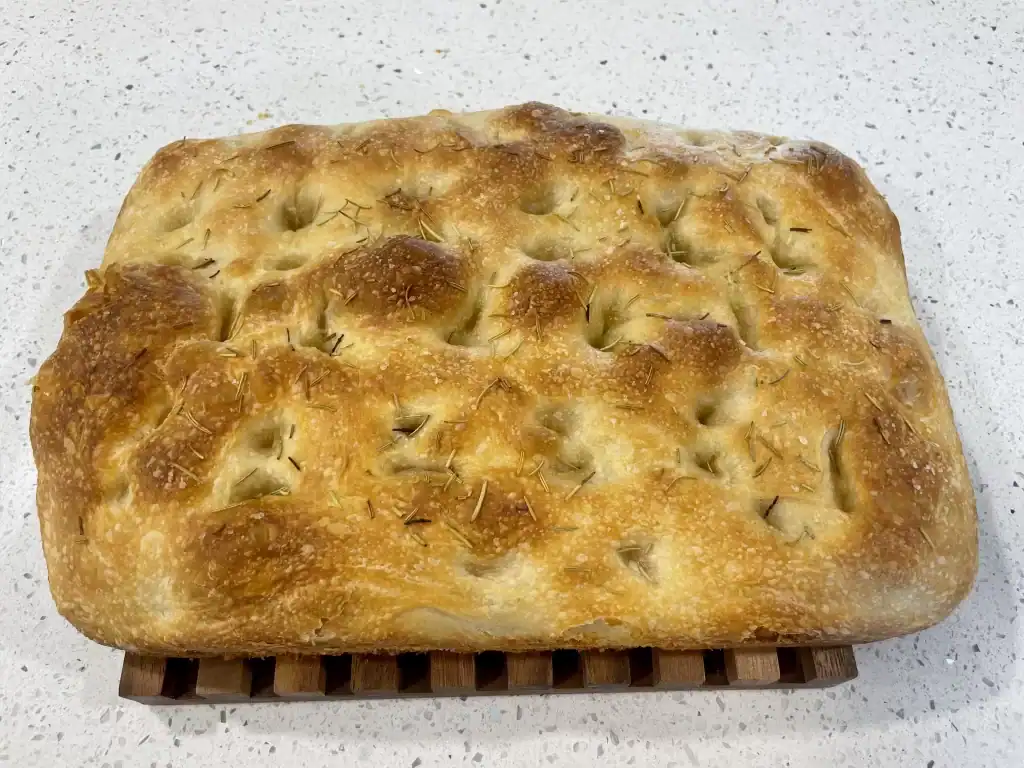
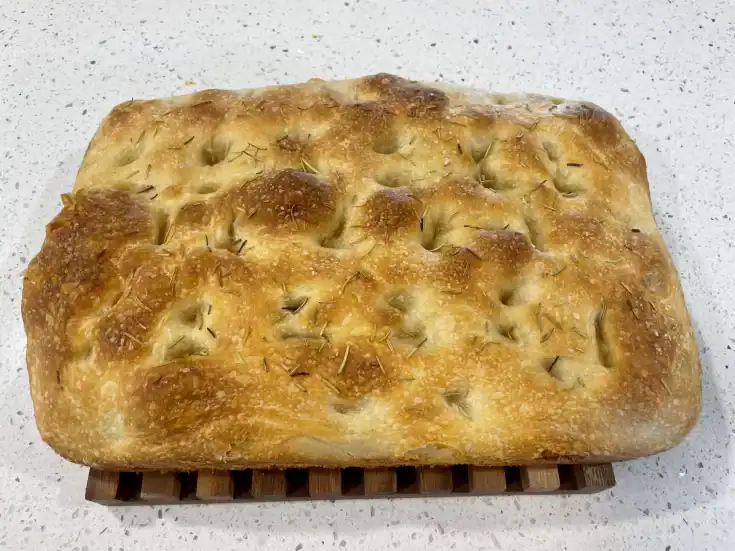
This easy sourdough focaccia recipe is easy to make for both new and experienced sourdough bread bakers. The dough is basically set-it-and-forget it, and the shaping method could not be simpler! Add to that a simple, time-tested topping combination of salt and dried rosemary and you’ve got a winning focaccia on your hands.
Ingredients You’ll Need
- Bread Flour: I prefer to use King Arthur brand bread flour for this recipe (the one in the blue bag). Any white bread flour that has around a 12-13% protein content will work perfectly. This type of flour will make a focaccia with the perfect balance of tenderness and chewiness.
- Water: Un-chlorinated tap water or bottled spring water are ideal for this recipe. You may need to use less water or more water depending on how much water your particular flour requires. See the substitutions and additions section below for recommendations on adjusting water content.
- Salt: Kosher salt, sea salt, or plain table salt are ideal to use in this dough. This will help the bread rise appropriately as well as balance out the flavors.
- Sourdough Starter: It’s best to use a 100% hydration white sourdough starter for this recipe. That means that the starter should be made of mostly white bread flour or all purpose flour, and equal parts flour and water by weight. However, if you normally keep a sourdough starter fed with a different type of flour, that will be fine to use in this recipe too, since you will be feeding the starter white flour for the first step of this recipe.
- Olive Oil: This recipe utilizes olive oil within the dough as well as on top of the dough and to prevent the dough from sticking to the pan. Since olive oil is such a prominent ingredient in this easy sourdough focaccia, it’s best to use a high quality extra virgin olive oil, or at least an extra virgin olive oil with flavor that you like.
- Salt: Kosher salt, flaky sea salt, or another type of coarse salt are all great options for topping your focaccia.
- Dried Rosemary: I love to top my sourdough focaccia with dried rosemary and sea salt. You can use fresh rosemary if you have it, but I actually prefer the texture that dried rosemary adds to this bread.
Note: Check recipe card below for full ingredient amounts and quantities.
Substitutions and Additions
- Add Whole Grain Flour: Replace up to 50 grams of the bread flour with whole grain wheat flour to make a more wholesome focaccia with additional fiber. I find that adding any more whole grain than this will make the focaccia too dense and it will lose its classic fluffy texture.
- Choose Your Own Toppings: After adding olive oil and dimpling your focaccia during the “Topping and Baking” step, you can proceed to top your easy sourdough focaccia with almost any topping combination you can think of. A few tested ideas are: sun-dried tomatoes, sliced
How to Make Easy Sourdough Focaccia
Ingredients
Sourdough Starter Feeding
- Sourdough Starter, leftover – 25 grams
- Bread Flour – 50 grams
- Water – 50 grams
Final Dough
- Bread Flour – 450 grams
- Water – 325 grams
- Sourdough Starter, active – 100 grams
- Extra Virgin Olive Oil – 25 grams
- Salt – 10 grams
Toppings
- Extra Virgin Olive Oil – 25 grams
- Salt – 5 grams (1 tsp)
- Rosemary, dried – 1 gram (2 tsp)
Suggested Timeline
| Suggested Time | Step |
|---|---|
| 2:00 PM (Day 1) | Feeding Your Sourdough Starter |
| 8:00 PM | Mixing the Dough |
| 8:30 PM | Stretch and Folds |
| 10:00 PM | The First Rise (Bulk Fermentation) |
| 6:00 AM (Day 2) | Shaping |
| 6:05 AM | The Second Rise (The Final Proof) |
| 10:00 AM | Topping and Baking |
Easy Sourdough Focaccia (Step-by-Step Instructions)
Feeding Your Sourdough Starter
- Take 25 grams of leftover sourdough starter out of the fridge and feed it 50 grams bread flour and 50 grams of water. Stir the ingredients thoroughly to combine and mark the top of the starter with a rubber band. Cover the starter loosely with a lid and let it rise at room temperature for 6-8 hours, or until it doubles in size. It’s best to feed your starter in the middle of the day or in the afternoon, so that your starter is ready to use in the evening.
Mixing the Dough

- When your starter has doubled in size and it’s ready to use, add the following ingredients to a large mixing bowl: the water, salt, and sourdough starter. Stir the liquid ingredients together with a spoon to break up the starter and to dissolve the salt.
- Next, add all of the bread flour to the mixing bowl and stir the ingredients together until a rough dough forms. At this point, cover up the bowl with a kitchen towel and let the dough rest for 30 minutes.
- After the 30 minute rest, uncover the dough and add the 25 grams of olive oil right on top of the dough. Squeeze the oil into the dough with your hands until it is thoroughly combined with the dough and the dough starts to hold together again.
Stretch and Folds
- Immediately after squeezing in the oil, give the dough it’s first set of stretch and folds. Grab an edge of the dough and stretch it upwards, then when the dough begins to resist, fold it over the top of the dough. Continue stretching and folding the edges of the dough about 10-20 times total, or until the dough starts to resist your stretching and to firm up. After that, cover the dough up again and let it rest for 30 minutes.
- Give the dough a second set of stretch and folds. The dough should be smoother and hold together better than it did during the first set of stretch and folds. Cover the dough and let it rest for another 30 minutes.
- Finally, give the dough one last set of stretch and folds. Immediately flip the dough over so that the smooth side is facing up and the seam side is facing down.
The First Rise (Bulk Fermentation)
- Cover the mixing bowl with a layer of plastic wrap (or move the dough to a glass bowl with an airtight lid) and then let the dough rise at room temperature overnight, or for at least 6-8 hours. You want the dough to completely double in size overnight, which usually takes about 6-7 hours for me, but can take longer if your kitchen temperature is col. The next morning, your dough should be doubled in size and ready to shape.
Shaping
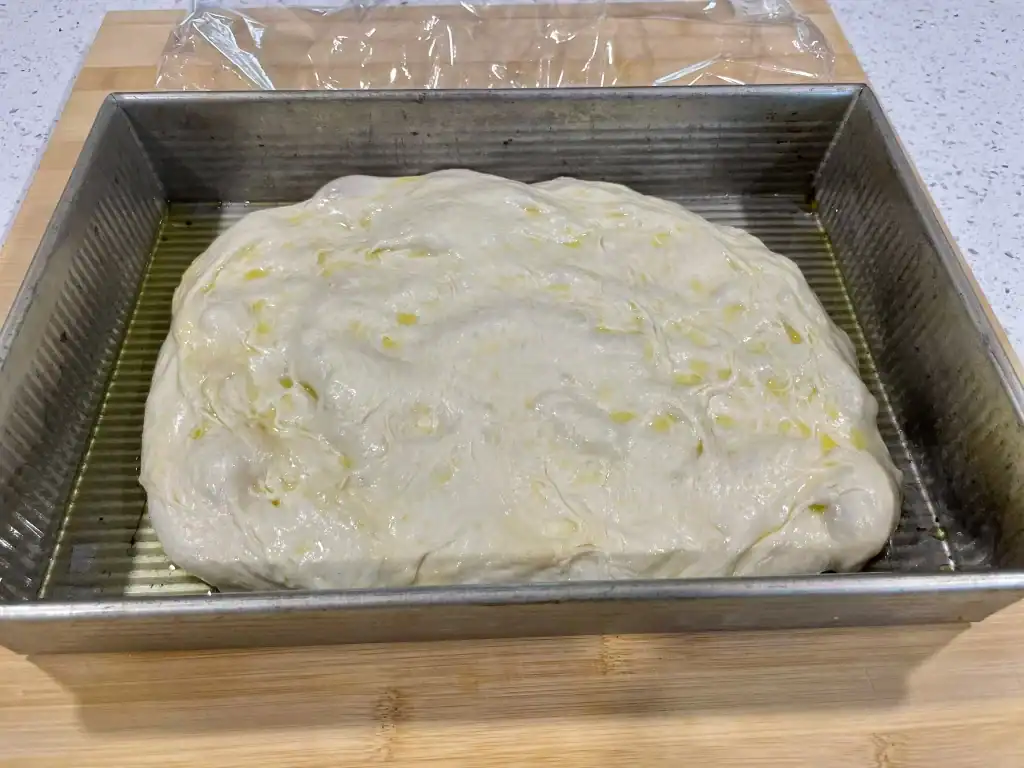
- Prepare a 9×13″ non-stick, metal cake pan by greasing it with 25 grams of olive oil. This will create an additional non-stick layer between the dough and the pan, but it will also give the sourdough focaccia its traditional fried-bottom texture and flavor.
- Turn out the risen dough into the oiled pan. Move the dough around carefully to get oil on both sides of the dough, and then flip the dough over so that the smooth side is facing up and the seam side is facing down.
- Gently pull on the edges of the dough to stretch it into a rectangular shape to match the pan. The dough likely won’t be able to stretch all the way to the edges of the pan at this point, but as long as it is rectangular, it will rise and fill up the pan during the final proof.
Final Proof
- Cover the pan with a layer of plastic wrap, or a lid, if your pan has one, and let the dough rise for 3-5 hours at room temperature. The dough should puff up and fill the pan during this time. Be sure to give the focaccia dough enough time to proof and fill the pan; even if it takes 6-8 hours, that’s OK.
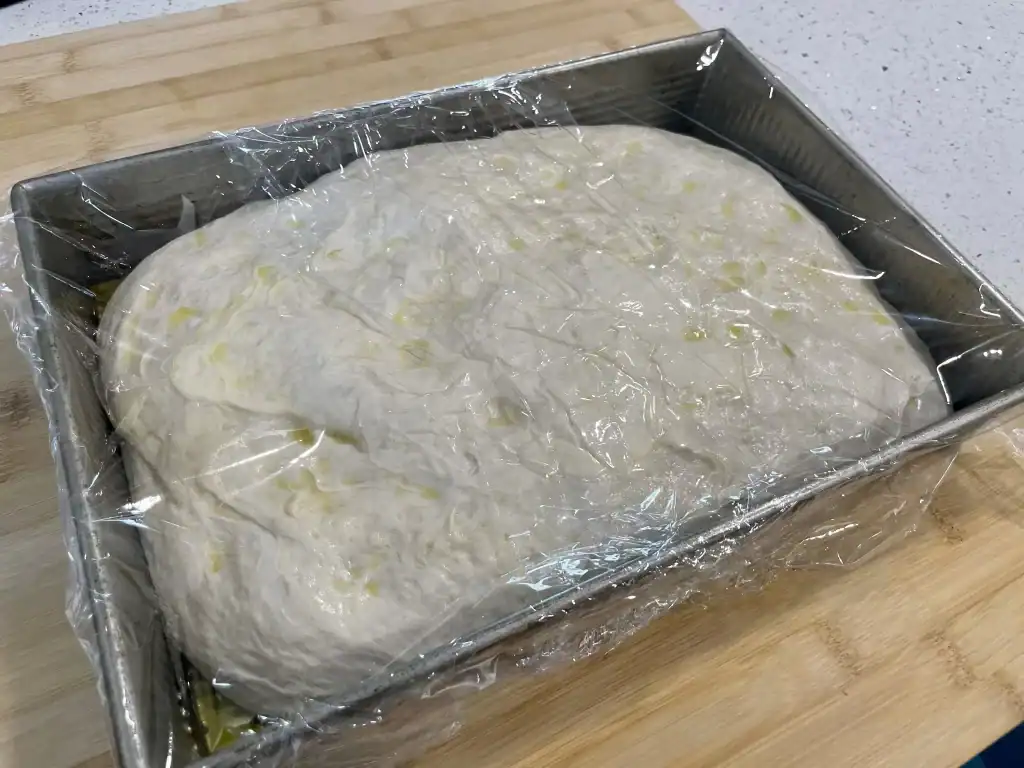
Note: After the dough has risen and filled the pan, you can move on to topping and baking the focaccia. If you’re not ready to bake yet, move the pan of dough to the fridge for up to 12 hours until you’re ready to bake it.
Topping and Baking
- Pre-heat your oven to 450°F (232°C) 30 minutes before you’re ready to bake. There is no need to add steam to your oven for this recipe. If you have a baking steel or pizza stone in your oven, feel free to use it, but you can also place the pan directly on the oven rack to bake.
- Uncover the risen focaccia dough and top it with 25 grams of olive oil. Wet your fingertips in the oil and dimple the top of the dough by pressing down all over the dough with your fingertips. (Don’t press through the dough to puncture it, but just press down gently until you feel the bottom of the pan.) Dimpling the dough will create bumps, ridges, and bubbles throughout the dough where oil and toppings can collect, creating pockets of flavor throughout the sourdough focaccia.

- After dimpling the dough, add your desired toppings. A few sprinkles of salt and a few teaspoons of dried rosemary is my favorite topping combination.
- To bake, slide the pan of dough onto your middle oven rack or onto the pizza stone in your oven. Bake the focaccia for 30-35 minutes at 450°F (232°C).
- Remove the focaccia from the oven when it is golden brown and slide it out of the non-stick cake pan and onto a wire rack. Let the focaccia cool for at least 30 minutes before slicing.
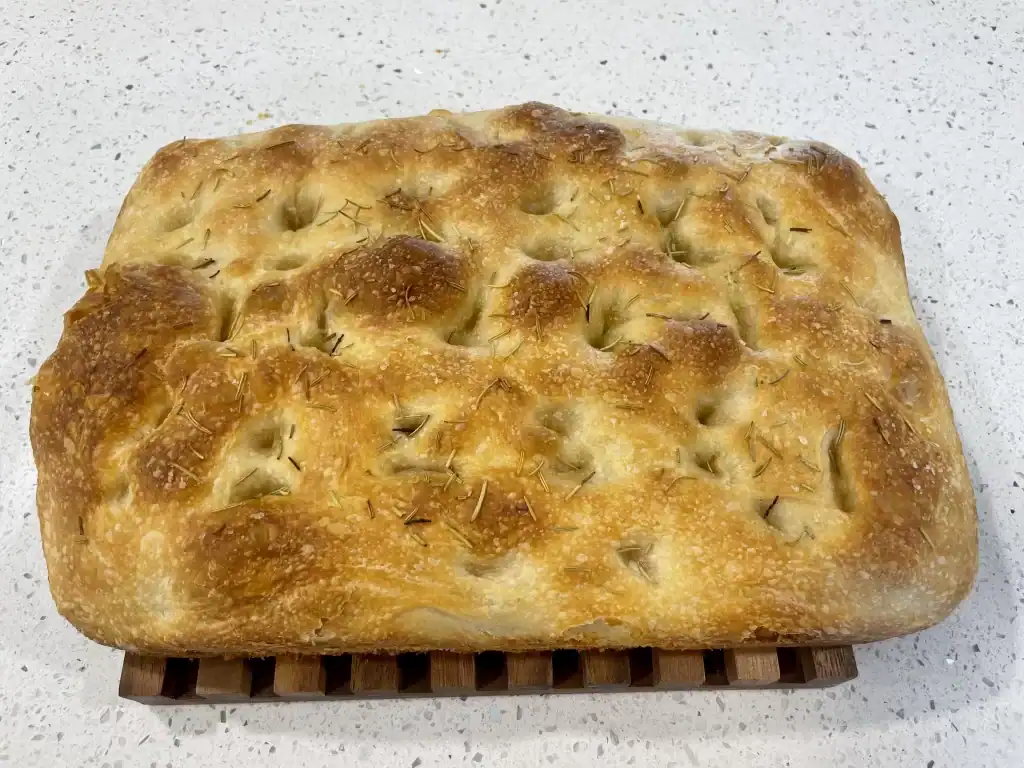
- Slice the focaccia into strips, or into sandwich-style slices for a delicious sandwich.
The mildly sour flavor of this easy sourdough focaccia pairs perfectly with soft cheeses and cured meats, but it is also great to enjoy on its own. I love the contrast between the crispy and crunch exterior of the focaccia and the soft and fluffy interior. This olive oil-infused dough is very rich and delicate and it’s one of my favorite sourdough breads to make.
Easy Sourdough Focaccia
This easy sourdough focaccia recipe is easy to make for both new and experienced sourdough bread bakers. The dough is basically set-it-and-forget it, and the shaping method could not be simpler! Add to that a simple topping combination of salt and dried rosemary and you've got a winning focaccia on your hands.
Ingredients
Sourdough Starter Feeding
- Sourdough Starer, leftover - 25 grams
- Bread Flour - 50 grams
- Water - 50 grams
Main Dough
- Bread Flour - 450 grams
- Water - 325 grams
- Sourdough Starter, active - 100 grams
- Salt - 10 grams
- Extra Virgin Olive Oil - 25 grams (plus more for greasing the pan)
Toppings
- Extra Virgin Olive Oil - 25 grams
- Salt - 5 grams (1 tsp)
- Rosemary, dried - 1 gram (2 tsp)
Instructions
Feeding Your Sourdough Starter
- Take 25 grams of leftover sourdough starter out of the fridge and feed it 50 grams bread flour and 50 grams of water. Stir the ingredients thoroughly to combine and mark the top of the starter with a rubber band. Cover the starter loosely with a lid and let it rise at room temperature for 6-8 hours, or until it doubles in size. It’s best to feed your starter in the middle of the day or in the afternoon, so that your starter is ready to use in the evening.
Mixing the Dough
- When your starter has doubled in size and it’s ready to use, add the following ingredients to a large mixing bowl: the water, salt, and sourdough starter. Stir the liquid ingredients together with a spoon to break up the starter and to dissolve the salt.
- Next, add all of the bread flour to the mixing bowl and stir the ingredients together until a rough dough forms. At this point, cover up the bowl with a kitchen towel and let the dough rest for 30 minutes.
- After the 30 minute rest, uncover the dough and add the 25 grams of olive oil right on top of the dough. Squeeze the oil into the dough with your hands until it is thoroughly combined with the dough and the dough starts to hold together again.
Stretch and Folds
- Immediately after squeezing in the oil, give the dough it’s first set of stretch and folds. Grab an edge of the dough and stretch it upwards, then when the dough begins to resist, fold it over the top of the dough. Continue stretching and folding the edges of the dough about 10-20 times total, or until the dough starts to resist your stretching and to firm up. After that, cover the dough up again and let it rest for 30 minutes.
- Give the dough a second set of stretch and folds. The dough should be smoother and hold together better than it did during the first set of stretch and folds. Cover the dough and let it rest for another 30 minutes.
- Finally, give the dough one last set of stretch and folds. Immediately flip the dough over so that the smooth side is facing up and the seam side is facing down.
The First Rise (Bulk Fermentation)
- Cover the mixing bowl with a layer of plastic wrap (or move the dough to a glass bowl with an airtight lid) and then let the dough rise at room temperature overnight, or for at least 6-8 hours. You want the dough to completely double in size overnight, which usually takes about 6-7 hours for me, but can take longer if your kitchen temperature is col. The next morning, your dough should be doubled in size and ready to shape.
Shaping
- Prepare a 9×13″ non-stick, metal cake pan by greasing it with 25 grams of olive oil. This will create an additional non-stick layer between the dough and the pan, but it will also give the sourdough focaccia its traditional fried-bottom texture and flavor.
- Turn out the risen dough into the oiled pan. Move the dough around carefully to get oil on both sides of the dough, and then flip the dough over so that the smooth side is facing up and the seam side is facing down.
- Gently pull on the edges of the dough to stretch it into a rectangular shape to match the pan. The dough likely won’t be able to stretch all the way to the edges of the pan at this point, but as long as it is rectangular, it will rise and fill up the pan during the final proof.
The Second Rise (Final Proof)
- Cover the pan with a layer of plastic wrap, or a lid, if your pan has one, and let the dough rise for 3-5 hours at room temperature. The dough should puff up and fill the pan during this time. Be sure to give the focaccia dough enough time to proof and fill the pan; even if it takes 6-8 hours, that’s OK.
Note: After the dough has risen and filled the pan, you can move on to topping and baking the focaccia. If you’re not ready to bake yet, move the pan of dough to the fridge for up to 12 hours until you’re ready to bake it.
Topping and Baking
- Pre-heat your oven to 450°F (232°C) 30 minutes before you’re ready to bake. There is no need to add steam to your oven for this recipe. If you have a baking steel or pizza stone in your oven, feel free to use it, but you can also place the pan directly on the oven rack to bake.
- Uncover the risen focaccia dough and top it with 25 grams of olive oil. Wet your fingertips in the oil and dimple the top of the dough by pressing down all over the dough with your fingertips. (Don’t press through the dough to puncture it, but just press down gently until you feel the bottom of the pan.) Dimpling the dough will create bumps, ridges, and bubbles throughout the dough where oil and toppings can collect, creating pockets of flavor throughout the sourdough focaccia.
- After dimpling the dough, add your desired toppings. A few sprinkles of salt and a few teaspoons of dried rosemary is my favorite topping combination.
- To bake, slide the pan of dough onto your middle oven rack or onto the pizza stone in your oven. Bake the focaccia for 30-35 minutes at 450°F (232°C).
- Remove the focaccia from the oven when it is golden brown and slide it out of the non-stick cake pan and onto a wire rack. Let the focaccia cool for at least 30 minutes before slicing.
- Slice the focaccia into strips, or into sandwich-style slices for a delicious sandwich.
Notes
- After the dough has risen and filled the pan, you can move on to topping and baking the focaccia. If you’re not ready to bake yet, move the pan of dough to the fridge for up to 12 hours until you’re ready to bake it.