

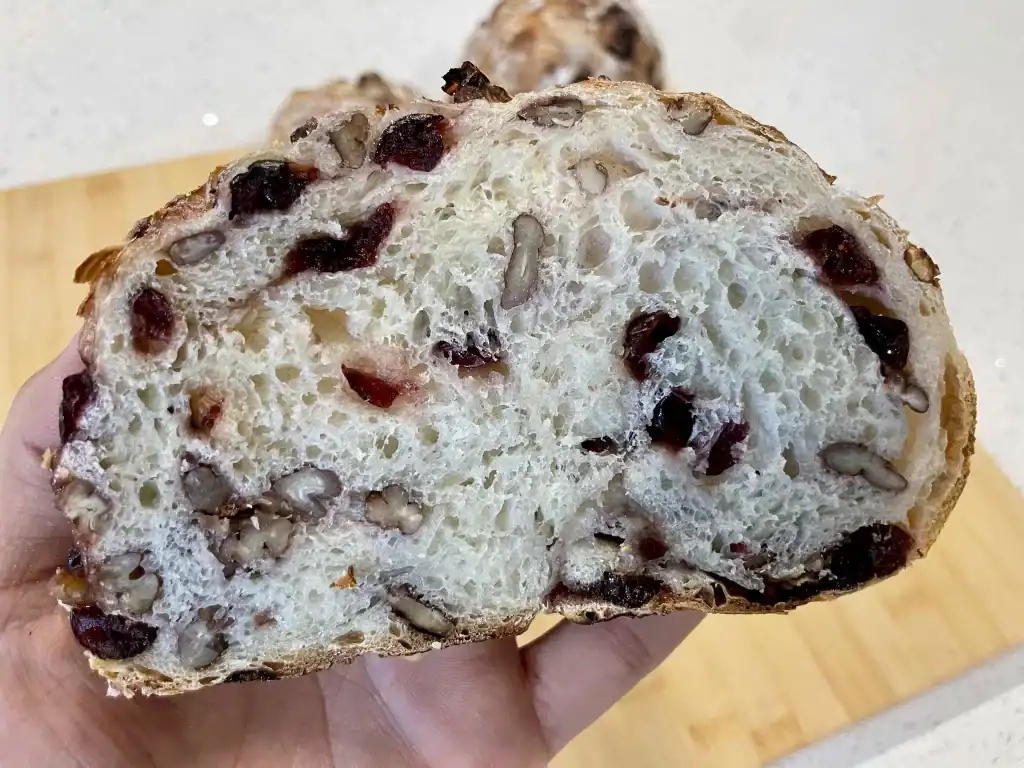
This loaf of cranberry pecan sourdough bread is deliciously warm and nutty, but with a hint of tanginess from the cranberries and sourdough starter. It’s a hearty and filling loaf of sourdough bread that will get you through the cold months of fall and winter.
Why This Recipe Works
Dried fruit and nuts are a classic combination to mix into a loaf of bread. (Raisin and walnut sourdough bread is a fairly common recipe that you might have seen before.) This cranberry pecan sourdough bread makes use of a whole bag of dried cranberries, which are widely available during the holiday season, and chopped pecans, which are easy to find in the baking aisle of the grocery store. These two ingredients come together beautifully to create a nutty, balanced, crunchy, and filling loaf of sourdough bread.
Ingredients You’ll Need
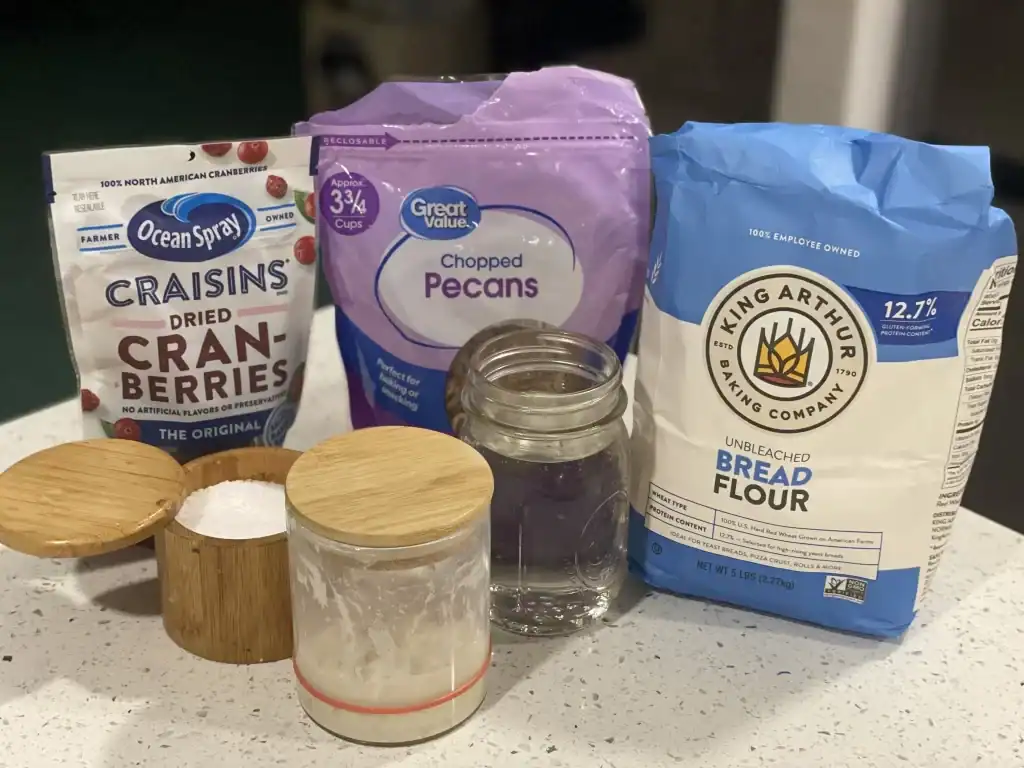
- Bread Flour: I use King Arthur brand of bread flour for this recipe. Any white bread flour that is around 12-13% protein will work well.
- Sourdough Starter: You’ll need a 100% hydration sourdough starter for this recipe (fed with equal parts water and flour by weight).
- Water: It’s best to use filtered tap water or bottled spring water for this bread dough.
- Cranberries, dried: To make one loaf of this cranberry pecan sourdough bread you’ll use a whole bag of dried cranberries (170 grams). I used the Ocean Spray brand of dried cranberries for this recipe.
- Pecans, chopped: Use raw pecans that come pre-chopped, or chop the pecans yourself for a fresher ingredient. Either way, I think chopped pecans mix throughout the entire loaf of bread easier compared to using whole pecans.
- Salt: I use Kosher salt for this recipe, but sea salt or plain table salt will work just as well.
Note: Check recipe card below for full ingredient amounts and quantities.
Substitutions and Additions
- Use Walnuts instead of Pecans: You can easily use chopped walnuts instead of chopped pecans for this recipe. Use whatever you have on hand or whichever nut you prefer.
- Use Sugar-Free Dried Cranberries: Bags of dried cranberries usually contain a small amount of white sugar which is used in the preserving process (and because cranberries are extremely tart). Sugar-free dried cranberries are almost impossible to find, but I have found them before at Trader Joe’s (here’s an affiliate link to the Trader Joe’s product on Amazon). If you want to make a sourdough bread free from added refined sugars, look for sugar-free dried cranberries at a specialty store or try making your own dried cranberries at home with maple syrup (here’s a simple recipe that I found online).

How to Make Cranberry Pecan Sourdough Bread
Ingredient Amounts
Sourdough Starter Feeding
- Sourdough Starter, leftover – 25 grams
- Bread Flour – 50 grams
- Water – 50 grams
Main Dough
- Bread Flour – 450 grams
- Water – 325 grams
- Sourdough Starter – 100 grams
- Salt – 10 grams
Inclusions
- Cranberries, dried – 170 grams
- Pecans, chopped – 130 grams
Suggested Timeline
Room Temperature Final Proof
| Time | Step |
|---|---|
| 9:00 PM (Day 1) | Feeding the Sourdough Starter |
| 6:00 AM (Day 2) | Mixing the Dough |
| 6:30 AM | Stretch and Folds + Adding the Inclusions |
| 7:30 AM | The First Rise (Bulk Fermentation) |
| 5:30 PM | Shaping |
| 6:00 PM | Final Proof at Room Temperature |
| 8:00 PM | Baking |
Cold Final Proof – Recommended
| Time | Step |
|---|---|
| 9:00 PM (Day 1) | Feeding the Sourdough Starter |
| 7:00 AM (Day 2) | Mixing the Dough |
| 7:30 AM | Stretch and Folds + Adding the Inclusions |
| 8:30 AM | The First Rise (Bulk Fermentation) |
| 6:30 PM | Shaping |
| 7:00 PM | Final Proof in the Fridge |
| 8:00 AM (Day 3) | Baking |
Step-by-Step Instructions for Cranberry Pecan Sourdough Bread
Feeding the Sourdough Starter
- Take 25 grams of sourdough starter out of the fridge. Add 50 grams of water to the starter and stir to dissolve. Then add 50 grams of bread flour and stir the starter until you have a pancake batter-like consistency. Mark the top of the starter with a rubber band and cover the starter jar loosely with a lid. Let the starter rise overnight for 6-12 hours, or until doubled in size. I usually feed my starter in the evening and by morning time, the starter is risen and ready to use.
Mixing the Dough
- When your starter has about doubled in size, it’s time to mix the dough. Place a medium or large sized mixing bowl on top of a digital scale. To the mixing bowl, add the water, salt, and 100 grams of sourdough starter. Stir the ingredients thoroughly to combine.
- Next, add all of the bread flour and mix it into the liquid ingredients. Keep mixing until all of the dry clumps of flour are gone and you have a shaggy dough. Cover up the dough with a kitchen towel and let the dough rest for 30 minutes.
- 30 minutes later the dough will hold together much better and you’ll be ready to perform the first set of stretch and folds.
Stretch and Folds + Adding the Inclusions
- For the first set of stretch and folds, grab an edge of the dough and stretch it up into the air and fold it over the top of the dough. Then give the bowl a quarter turn and repeat the process until you have stretched and folded the dough a total of four times. This will help build strength and structure into the dough and it will be easier to incorporate the cranberries and pecans later.
- Cover up the dough and let it rest for another 30 minutes.

- 30 minutes later, it’s time to add the dried cranberries and chopped pecans to the dough. Into a small bowl add the entire listed amount of cranberries and chopped pecans and mix them together until thoroughly combined. You will add the fruit and nuts to the dough in two separate additions (half during the 2nd set of stretch and folds, and half during the 3rd set of stretch and folds).
- For the second set of stretch and folds, uncover the dough and pour half of the cranberry pecan mixture right on top of the dough. Press the fruit and nuts down so that they stick into the dough. Then give the dough another set of stretch and folds: grab an edge of the dough and stretch it up into the air and fold it over the top of the dough. Repeat this process a total of four times. This will gently incorporate the cranberries and pecans into the dough in layer.

- Cover the dough with a kitchen towel and let it rest for another 30 minutes.
- 30 minutes later, perform the third and final set of stretch and folds: Add the remaining half of the cranberries and pecans on top of the dough and press them down. Then, fold the dough four more times to incorporate the inclusions.
The First Rise (Bulk Fermentation)
- After all of the dried cranberries and pecans are folded into the dough, move the dough to a container to rise. (I prefer an oiled glass bowl with a lid.) Flip the dough over so that the seam side is facing down and the smooth side is facing up, and place it into the oiled glass bowl.
- Cover the bowl tightly with a lid, a sheet of plastic wrap, or a kitchen towel, and let the dough rise at room temperature on your kitchen counter for 9-12 hours, or until it roughly doubles in size.
Note: This dough will take a long time to rise due to the amount of inclusions in the dough that are weighing it down, so be patient. Wait until it is almost doubled in size before moving on to the next step; cutting off the first rise too early will lead to a denser less airy bread. To speed up the rising process, let your dough rise in a warm area of your kitchen.
- Once the dough has roughly doubled in size, move on to the shaping step.
Shaping
- Pre-shape the dough into a ball: Take the risen dough out of the glass bowl and transfer it onto an un-floured surface of your kitchen counter. Gently cup and pull the piece of dough with your hands until you’ve created a tight ball of dough.
- Let the ball of dough rest, uncovered, on the kitchen counter for 30 minutes.

- When the dough has rested for 30 minutes, prepare a 10-inch oval banneton basket by dusting it with a bit of bread flour or rice flour.
- Shape the dough ball into an oval: Pick the dough ball up with your hands and flip it over so that the smooth side is facing down and the sticky seam side is facing up. Fold the dough in half once like a book, and press the seam together. Then, turn the dough 90° and fold the dough in half once again and press the seam together. This will create a long, oval-shaped dough that is fairly easy to shape. Watch the recipe video for a demonstration of this shaping technique.
- Transfer the dough into the banneton basket with the smooth side facing down and the sticky seam side facing up. Cover the dough up with a kitchen towel and it’s time for the final proof.

Final Proof
- Room Temperature Final Proof (Option 1): For a faster room temperature final proof, let the dough rise for 2-3 hours on your kitchen counter, or until it has grown to about 1.5x its size (you should notice it rise quite a bit in the banneton basket). Then, it’s ready to bake.
- Cold Final Proof (Option 2 – Preferred): For a slower cold proof that might fit into your schedule better, move the covered dough to the fridge and let it proof in the cold environment for 8-24 hours. Whenever you are ready to bake the bread the next day, the dough will be ready and waiting for you. Just pop it out of the fridge and it will be ready to bake.
Note: If you’re doing a cold final proof, the dough won’t visibly rise as much in the banneton basket as compared to a room temperature final proof. This is nothing to worry about. As long as the dough rose to double in size during the first rise (bulk fermentation), then it will be ready to bake after at least eight hours of final proof in the fridge.
Baking
- 30 minutes before you’re ready to bake, pre-heat your oven to 450°F (232°C). Keep your Dutch oven, Challenger Bread Pan, or baking vessel in the middle rack of the oven to pre-heat as well.
- When your oven is pre-heated, take your dough out of the fridge (if doing a cold final proof) and prepare a piece of parchment paper that is a little bit larger than the dough.
- Place the parchment paper on top of the dough and then flip the banneton basket over so that the dough slides out of the banneton basket and onto the parchment paper. Now, the dough should be right-side-up and it can be maneuvered on the parchment paper easily.
- Cut three short, diagonal slashes across the top of the dough with a razor blade or a bread lame (here’s the bread lame that I used with a 10% discount code).
- Grab the ends of the parchment paper and transfer the scored dough, parchment paper and all, into your Dutch oven or baking vessel. Close the lid of the Dutch oven to trap the steam, and bake for 20 minutes at 450°F (232°C).
- After the initial 20 minutes of baking, take the lid off of the Dutch oven to release the steam and you should see that your dough has risen significantly. With the lid removed, continue baking for another 30-35 minutes until the loaf of bread is golden brown.
- Transfer the baked loaf of bread onto a wooden or wire cooling rack to cool for at least one hour before slicing into the loaf. Cutting the bread too early can give the bread a gummy texture.
- Enjoying a slice of this cranberry pecan sourdough bread toasted with a slather of butter is a great way to get through a cold winter’s day.
Cranberry Pecan Sourdough Bread

This loaf of cranberry pecan sourdough bread is deliciously warm and nutty, but with a hint of tanginess from the cranberries and sourdough starter. It’s a hearty and filling loaf of sourdough bread that will get you through the cold months of fall and winter.
Ingredients
Sourdough Starter Feeding
- Sourdough Starter, leftover - 25 grams
- Water - 50 grams
- Bread Flour - 50 grams
Main Dough
- Bread Flour - 450 grams
- Water - 325 grams
- Sourdough Starter - 100 grams
- Salt - 10 grams
Inclusions
- Cranberries, dried - 170 grams
- Pecans, chopped - 130 grams
Instructions
Feeding the Sourdough Starter
- Take 25 grams of sourdough starter out of the fridge. Add 50 grams of water to the starter and stir to dissolve. Then add 50 grams of bread flour and stir the starter until you have a pancake batter-like consistency. Mark the top of the starter with a rubber band and cover the starter jar loosely with a lid. Let the starter rise overnight for 6-12 hours, or until doubled in size. I usually feed my starter in the evening and by morning time, the starter is risen and ready to use.
Mixing the Dough
- When your starter has about doubled in size, it’s time to mix the dough. Place a medium or large sized mixing bowl on top of a digital scale. To the mixing bowl, add the water, salt, and 100 grams of sourdough starter. Stir the ingredients thoroughly to combine.
- Next, add all of the bread flour and mix it into the liquid ingredients. Keep mixing until all of the dry clumps of flour are gone and you have a shaggy dough. Cover up the dough with a kitchen towel and let the dough rest for 30 minutes.
- 30 minutes later the dough will hold together much better and you’ll be ready to perform the first set of stretch and folds.
Stretch and Folds + Adding the Inclusions
- For the first set of stretch and folds, grab an edge of the dough and stretch it up into the air and fold it over the top of the dough. Then give the bowl a quarter turn and repeat the process until you have stretched and folded the dough a total of four times. This will help build strength and structure into the dough and it will be easier to incorporate the cranberries and pecans later.
- Cover up the dough and let it rest for another 30 minutes.
- 30 minutes later, it’s time to add the dried cranberries and chopped pecans to the dough. Into a small bowl add the entire listed amount of cranberries and chopped pecans and mix them together until thoroughly combined. You will add the fruit and nuts to the dough in two separate additions (half during the 2nd set of stretch and folds, and half during the 3rd set of stretch and folds).
- For the second set of stretch and folds, uncover the dough and pour half of the cranberry pecan mixture right on top of the dough. Press the fruit and nuts down so that they stick into the dough. Then give the dough another set of stretch and folds: grab an edge of the dough and stretch it up into the air and fold it over the top of the dough. Repeat this process a total of four times. This will gently incorporate the cranberries and pecans into the dough in layer.
- Cover the dough with a kitchen towel and let it rest for another 30 minutes.
- 30 minutes later, perform the third and final set of stretch and folds: Add the remaining half of the cranberries and pecans on top of the dough and press them down. Then, fold the dough four more times to incorporate the inclusions.
The First Rise (Bulk Fermentation)
- After all of the dried cranberries and pecans are folded into the dough, move the dough to a container to rise. (I prefer an oiled glass bowl with a lid.) Flip the dough over so that the seam side is facing down and the smooth side is facing up, and place it into the oiled glass bowl.
- Cover the bowl tightly with a lid, a sheet of plastic wrap, or a kitchen towel, and let the dough rise at room temperature on your kitchen counter for 9-12 hours, or until it roughly doubles in size.
Note: This dough will take a long time to rise due to the amount of inclusions in the dough that are weighing it down, so be patient. Wait until it is almost doubled in size before moving on to the next step; cutting off the first rise too early will lead to a denser less airy bread. To speed up the rising process, let your dough rise in a warm area of your kitchen.
- Once the dough has roughly doubled in size, move on to the shaping step.
Shaping
- Pre-shape the dough into a ball: Take the risen dough out of the glass bowl and transfer it onto an un-floured surface of your kitchen counter. Gently cup and pull the piece of dough with your hands until you’ve created a tight ball of dough.
- Let the ball of dough rest, uncovered, on the kitchen counter for 30 minutes.
- When the dough has rested for 30 minutes, prepare a 10-inch oval banneton basket by dusting it with a bit of bread flour or rice flour.
- Shape the dough ball into an oval: Pick the dough ball up with your hands and flip it over so that the smooth side is facing down and the sticky seam side is facing up. Fold the dough in half once like a book, and press the seam together. Then, turn the dough 90° and fold the dough in half once again and press the seam together. This will create a long, oval-shaped dough that is fairly easy to shape. Watch the recipe video for a demonstration of this shaping technique.
- Transfer the dough into the banneton basket with the smooth side facing down and the sticky seam side facing up. Cover the dough up with a kitchen towel and it’s time for the final proof.
Final Proof
- Room Temperature Final Proof (Option 1): For a faster room temperature final proof, let the dough rise for 2-3 hours on your kitchen counter, or until it has grown to about 1.5x its size (you should notice it rise quite a bit in the banneton basket). Then, it’s ready to bake.
- Cold Final Proof (Option 2 – Preferred): For a slower cold proof that might fit into your schedule better, move the covered dough to the fridge and let it proof in the cold environment for 8-24 hours. Whenever you are ready to bake the bread the next day, the dough will be ready and waiting for you. Just pop it out of the fridge and it will be ready to bake.
Note: If you’re doing a cold final proof, the dough won’t visibly rise as much in the banneton basket as compared to a room temperature final proof. This is nothing to worry about. As long as the dough rose to double in size during the first rise (bulk fermentation), then it will be ready to bake after at least eight hours of final proof in the fridge.
Baking
- 30 minutes before you’re ready to bake, pre-heat your oven to 450°F (232°C). Keep your Dutch oven, Challenger Bread Pan, or baking vessel in the middle rack of the oven to pre-heat as well.
- When your oven is pre-heated, take your dough out of the fridge (if doing a cold final proof) and prepare a piece of parchment paper that is a little bit larger than the dough.
- Place the parchment paper on top of the dough and then flip the banneton basket over so that the dough slides out of the banneton basket and onto the parchment paper. Now, the dough should be right-side-up and it can be maneuvered on the parchment paper easily.
Cut three short, diagonal slashes across the top of the dough with a razor blade or a bread lame (here’s the bread lame that I used with a 10% discount code). - Grab the ends of the parchment paper and transfer the scored dough, parchment paper and all, into your Dutch oven or baking vessel. Close the lid of the Dutch oven to trap the steam, and bake for 20 minutes at 450°F (232°C).
- After the initial 20 minutes of baking, take the lid off of the Dutch oven to release the steam and you should see that your dough has risen significantly. With the lid removed, continue baking for another 30-35 minutes until the loaf of bread is golden brown.
- Transfer the baked loaf of bread onto a wooden or wire cooling rack to cool for at least one hour before slicing into the loaf. Cutting the bread too early can give the bread a gummy texture.
Enjoying a slice of this cranberry pecan sourdough bread toasted with a slather of butter is a great way to get through a cold winter’s day.