

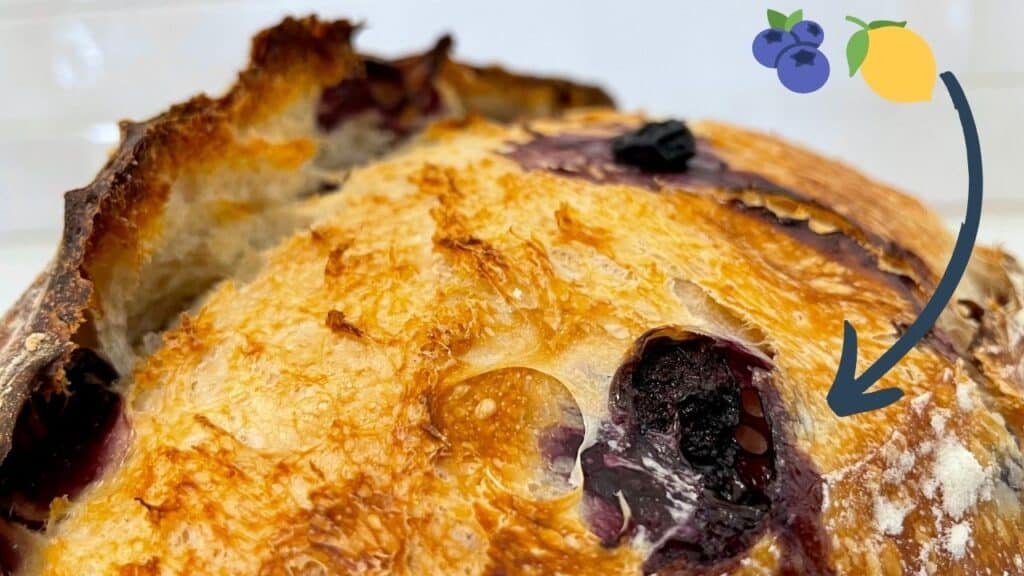
This blueberry lemon sourdough bread recipe brings together fresh blueberries and lemon zest to create a beautiful and fruity loaf of sourdough bread. With a crispy crust and an extra soft interior, this bread does not disappoint.
Ingredients You’ll Need
- Bread Flour: I used King Arthur bread flour for this recipe. You can use any plain white bread flour that contains around 11-13% protein.
- Water: Plain, unchlorinated tap water is best. Use filtered water or bottled spring water if your city’s tap water contains harsh ingredients or has a bad taste.
- Sourdough Starter: You’ll need a 100% hydration sourdough starter for this recipe. You can feed your starter directly and don’t need to create a separate “levain.”
- Salt: I used Kosher salt for this recipe, but sea salt or plain table salt will also work well.
- Fresh Blueberries: Fresh, in season, blueberries are best, but as long as you use ther best tasting fresh blueberries you can find, the bread will be great.
- Lemon Zest: This recipe calls for the zest from two standard sized lemons, or about 2 tablespoons of lemon zest. I zested fresh lemons myself with a Microplane-style zester.
- White Sugar: You’ll use a small amount of sugar to mix with the lemon zest. The sugar will extract the lemon oil from the zest and make your bread taste even more like lemon!
Note: See recipe card below for full ingredient amounts and quantities.
Ingredient Amounts
Starter Feeding
- Sourdough Starter, leftover – 25 grams
- Water – 50 grams
- Bread Flour – 50 grams
Main Dough
- Bread Flour – 450 grams
- Water – 325 grams
- Sourdough Starter, active – 100 grams
- Salt – 10 grams
Inclusions
- Blueberries, fresh – 150 grams (1/2 pint)
- White Sugar – 25 grams (2 Tbsp)
- Lemon Zest – Zest from two lemons (2 Tbsp)
Suggested Timeline
| Time | Step |
|---|---|
| 10:00 PM (Day 1) | Feeding the Sourdough Starter |
| 6:00 AM (Day 2) | Creating the Sugar/Lemon Zest Mixture |
| 6:03 AM | Mixing the Dough |
| 6:30 AM | Stretch and Folds – Adding Lemon Zest and Blueberries |
| 7:30 AM | The First Rise (Bulk Fermentation) |
| 10:30 AM | Shaping |
| 11:00 AM | The Second Rise (Final Proof) |
| 1:00 PM | Baking |
How to Make Blueberry Lemon Sourdough Bread
Step-by-Step Instructions
Feeding the Sourdough Starter
Take 25 grams of leftover sourdough starter out of the fridge. Feed your starter 50 grams of water and 50 grams of bread flour. Mix the flour, water, and starter around until it has a pancake batter consistency. Mark the top of the starter with a rubber band and cover the top loosely with a lid. Let the starter rise at room temperature overnight, for around 6-8 hours, or until it doubles in size.
Creating the Sugar/Lemon Zest Mixture
The next morning, zest two average-size lemons with a microplane or other citrus zester. Mix the zest from the two lemons with 25 grams (2 Tbps) of white sugar. The sugar will make the sourdough bread softer, but it will also help extract the flavorful lemon oils from the lemon zest. Allow the sugar and lemon zest mixture to rest in a bowl until you add it to the dough during the “stretch and folds” step.
Mixing the Dough
Place a mixing bowl on a stand mixer and add the 325 grams of water and 100 grams of active and risen sourdough starter. Stir the starter into the water with a spoon to dissolve it into the water. Then, add 450 grams of bread flour and 10 grams of salt. Mix the dough together for about 1-2 minutes until there aren’t any dry clumps of flour left. At this point, cover the bowl with a kitchen towel and let the dough rest for 30 minutes.
Stretch and Folds – Adding the Lemon Zest and Blueberries
You will perform three sets of stretch and folds with 30 minutes of rest in between each set. During the stretch and folds you will incorporate the lemon zest mixture and the fresh blueberries.
For the first set of stretch and folds, pour the sugar and lemon zest mixture on top of the dough and dimple it into the dough with your finger tips. Stretch and fold the dough four times to incorporate the lemon zest mixture and to start developing the gluten structure of the dough. Cover the dough with a kitchen towel and let it rest for 30 minutes.
For the second set of stretch and folds, pour half of the total amount of fresh blueberries on top of the dough. Press the berries into the dough with your fingertips until they stick. Give the dough four folds to slowly incorporate the blueberries in layers. Cover the dough with a kitchen towel and let it rest for 30 minutes.
For the last set of stretch and folds, pour the remaining half of the blueberries on top of the dough and press them down until they stick. Give the dough another four folds to incorporate the remaining blueberries.
The First Rise (Bulk Fermentation)
Transfer the dough seam-side-down and smooth-side-up into an oiled glass bowl with a lid. Close the air tight lid or cover the bowl with a sheet of plastic wrap. Allow the dough to rise at room temperature for 3-5 hours, or until the dough is puffy, risen, and about doubled in size.
Shaping the Blueberry Lemon Sourdough Loaf
To shape the blueberry lemon sourdough bread into an oval shape, first preshape the dough into a ball. Take the dough out of the bowl and place it onto the kitchen counter. Cup and pull the dough with your hands using a circular motion to shape the dough into a tight ball. Let the uncovered ball of dough rest on the counter (bench rest) for 30 minutes. During this time the dough will relax and it will be easier to shape the dough into an oval shape later.
30 minutes later, prepare a 10″ oval banneton basket by dusting it generously with bread flour. Sprinkle the top of the dough with a little bit of bread flour as well. Flip the dough over so that the floured side is against the counter and the sticky side is facing up. Gently pull the corners of the dough into a square shape. Fold the left third of the dough over the middle third, and then fold the right third of the dough over the middle third as well. Press down the seam where the two thirds meet in the middle. Take the end of dough that is furthest away from you and roll the dough into itself until it creates a tight cylinder of dough. Tuck the ends of the dough under to smooth out the sides, and now you have an oval shaped dough that will fit in your banneton basket.
The Second Rise (Final Proof)
Flip the shaped dough upside down and place it gently into your oval banneton basket. Pinch any visible seams in the dough closed with your finger tips.
Same-day baking option: Cover up the dough with a kitchen towel and let the dough rise at room temperature for 2-3 hours, or until it is almost but not quite doubled in size.
Next-day baking option: Cover up the dough with a kitchen towel and let the dough rise at room temperature for 1 hour, and then move it into the fridge to rise slowly overnight. Then, you can take the cold dough out of the fridge and bake it whenever you want to the next day.
Baking the Blueberry Lemon Sourdough Bread
30 minutes before the dough is done proofing, preheat your oven to 450°F (232°C) with a Dutch oven or other baking vessel in the middle rack of your oven.
After the dough is done proofing, flip the dough out of the banneton basket and onto a sheet of parchment paper. Score the dough with one long slash using a razor blade or bread lame. Transfer the dough, parchment paper and all, into the hot Dutch oven, and close the Dutch oven lid to trap the steam. Bake at 450°F (232°C) for 20 minutes.
20 minutes later, remove the lid of the Dutch oven and continue baking for another 15 minutes with the lid off.
Let the bread cool on a cooling rack for at least an hour before slicing in. Enjoy a thin, toasted slice of this blueberry lemon sourdough bread toasted with a slather of whole milk ricotta cheese (or butter or cream cheese) and then a drizzle of honey. It’s amazing.